

Wings of the Early Era
Long before jets dominated the skies, aviation relied on the power of propellers and ingenuity. From the graceful gliders of the Wright brothers to the iconic piston-engine airliners like the Lockheed Constellation and Boeing B-377, this era laid the foundation for modern commercial flight. Explore the milestones, designs, and pioneering pilots that made the dream of air travel a reality.
1904
Wright Flyer
Designed and built by Wilbur and Orville Wright, the 1904 Wright Flyer was the first aircraft capable of sustained, controlled, powered flight. Tested at Huffman Prairie in Dayton, Ohio, it marked a turning point in human history and laid the foundation for modern aviation. Its simple wooden frame and lightweight engine demonstrated that lift, thrust, and control could work together in flight.

Specifications
Powerplant: 12 hp, 4-cylinder Wright engine
Wingspan: 32 ft (9.8 m)
Top Speed: ~30 mph (48 km/h)
Range: ~0.25 miles (0.4 km)
Structure: Wood frame with fabric covering
Location: Huffman Prairie, Dayton, Ohio


1926
Ford Trimotor
Nicknamed the “Tin Goose,” the Ford Trimotor helped bring air travel to the public in the late 1920s and early ’30s. Built by the Ford Motor Company, it was one of the first all-metal airliners and proved that commercial aviation could be safe, practical, and profitable.
The Trimotor served with early airlines like Transcontinental Air Transport and Pan American Airways, connecting cities and even flying into rugged terrain. Though retired from major airlines by the mid-1930s, many continued flying for decades in cargo, bush, and sightseeing roles.
Specifications
Powerplant: 3 × Wright R-975 Whirlwind radial engines (220 hp each)
Wingspan: 77 ft (23.5 m)
Top Speed: 130 mph (209 km/h)
Range: ~500 miles (805 km)
Structure: Corrugated aluminum skin
Capacity: 8–12 passengers
The DC-3 revolutionized air travel. For the first time, flying became practical and profitable, not just an adventure for the wealthy. It could carry over 20 passengers comfortably and link cities across the country without constant fuel stops. During World War II, it served as the C-47 “Skytrain,” transporting soldiers and supplies on nearly every front. After the war, many DC-3s returned to civilian life, flying passengers, mail, and cargo for decades. Some are still flying today, serving as a true symbol of timeless engineering.
1935
Douglas DC-3


Specifications
Powerplant: 2 × Pratt & Whitney R-1830 Twin Wasp radial engines (1,200 hp each)
Wingspan: 95 ft (29 m)
Top Speed: 200 mph (322 km/h)
Range: 1,500 miles (2,400 km)
Structure: All-metal, low-wing monoplane
Capacity: 21–32 passengers
Cruising Altitude: ~10,000 ft (3,000 m)
Years of Service: 1935–present (some still operational worldwide)
1942
Douglas DC-4
Introduced in 1942, the Douglas DC-4 marked a major leap from the DC-3. With four engines, a pressurized cabin, and a tricycle landing gear instead of the DC-3’s tailwheel, it offered smoother takeoffs and landings and greater passenger comfort. Initially serving in World War II as the C-54 Skymaster, it later became a key aircraft for postwar commercial aviation, connecting continents with reliability and ease.


Specifications
Powerplant: 4 × Pratt & Whitney R-2000 Twin Wasp radial engines (1,450 hp each)
Wingspan: 117 ft 6 in (35.8 m)
Top Speed: 227 mph (365 km/h)
Range: 4,200 miles (6,760 km)
Structure: All-metal, low-wing monoplane
Capacity: 40–80 passengers
Cruising Altitude: ~20,000 ft (6,100 m)
Years of Service: 1942–1970s (some still used for cargo and firefighting)
1946
Douglas DC-6
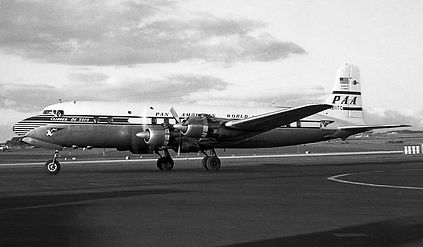
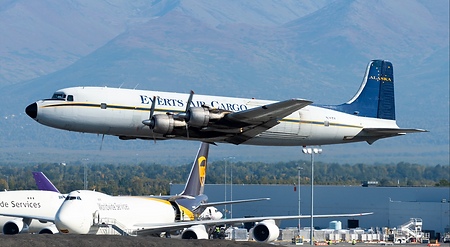
Compared to its predecessors, the DC-6 was a major leap forward in both comfort and performance. While the DC-3 had revolutionized air travel in the 1930s and the DC-4 brought long-range capability during World War II, neither offered pressurization — a key feature that allowed the DC-6 to fly higher, smoother, and faster above weather systems. It also carried nearly twice as many passengers as the DC-3 and cruised over 100 mph faster than the DC-4. In essence, the DC-6 marked Douglas’s transition from rugged utility to refined, global air travel — the final evolution before jets reshaped the skies.
Specifications
Powerplant: 4 × Pratt & Whitney R-2800-CB16 Double Wasp radial engines (2,400 hp each)
Wingspan: 117 ft 6 in (35.8 m)
Top Speed: 315 mph (507 km/h)
Range: 4,600 miles (7,400 km)
Structure: All-metal, pressurized fuselage
Capacity: 52–102 passengers
Cruising Altitude: ~25,000 ft (7,600 m)
Years of Service: 1946–1980s (some still used for cargo, charter, and firefighting)
1943
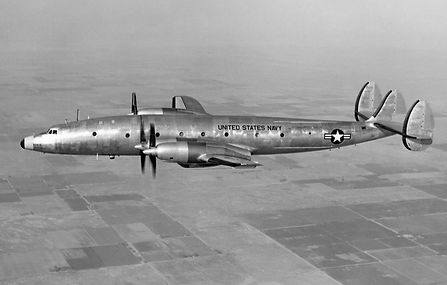
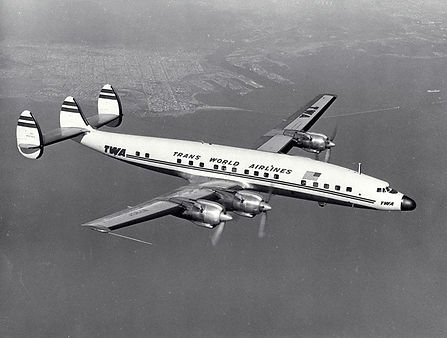
Lockheed Constellation
The Lockheed Constellation redefined long-range air travel in the 1940s and 1950s. Sleek, fast, and instantly recognizable by its triple-tail design, it brought pressurized comfort to intercontinental routes at a time when global travel still felt adventurous. Developed during World War II and later adapted for civilian use, the Constellation blended military-grade performance with airline elegance.
Compared to earlier transports like the DC-4, the Constellation flew higher and faster, shrinking ocean crossings and setting new expectations for refinement. Its curving fuselage and dolphin-like profile were not just stylistic choices. They reflected aerodynamic ambition. Airlines such as TWA and Pan Am used the aircraft to compete fiercely on prestige routes across the Atlantic and Pacific.
Powerplant: 4 × Wright R-3350 Duplex-Cyclone radial engines (2,200–3,400 hp each depending on variant)
Wingspan: 123 ft (37.5 m)
Top Speed: 340 mph (547 km/h)
Range: 5,400 miles (8,700 km) for later variants
Structure: Pressurized aluminum fuselage with distinctive triple vertical stabilizers
Capacity: 60–109 passengers depending on model
Cruising Altitude: 24,000 ft (7,300 m)
Years of Service: 1945–late 1960s
Specifications
Notable Variants
-
L-049 Constellation – Original production version introduced after World War II; pressurized long-range airliner derived from military C-69 development.
-
L-649 Constellation – Improved L-049 with higher fuel capacity and cabin upgrades for better range and passenger comfort.
-
L-749 Constellation – Increased fuel capacity for longer transatlantic routes. First flight: 1947.
-
L-1049 Super Constellation – Stretched fuselage with more powerful Wright R-3350 Duplex-Cyclone engines. Became the definitive Constellation. First flight: 1950.
-
L-1049G Super Constellation – Long-range, higher-weight version widely used on international routes. First flight: 1954.
-
L-1649A Starliner – Final and most advanced variant with redesigned longer wings for maximum range. The ultimate piston-powered Constellation. First flight: 1956.
1947
Boeing 377 Stratocruiser
The Boeing 377 Stratocruiser represented the height of luxury in the propeller age—a true masterpiece of design and engineering. Developed from the C-97 military transport and the B-29 bomber, it combined proven wartime technology with a civilian vision of elegance. Its double-deck cabin featured a spiral staircase leading to a lower-deck lounge, sleeping berths for overnight flights, and gourmet in-flight meals served on fine china—an experience few could afford but none forgot.
Technologically, it introduced pressurization and advanced aerodynamics for smoother, higher-altitude travel, setting new standards for passenger comfort. However, its massive four R-4360 engines made it costly to operate, and its reign was brief as the first jets soon arrived. Still, the Stratocruiser stands as the grand finale of the piston-powered era—an icon bridging the golden age of propellers and the dawn of the jet age.


Specifications
Powerplant: 4 × Pratt & Whitney R-4360 Wasp Major radial engines (3,500 hp each)
Wingspan: 141 ft (43 m)
Top Speed: 375 mph (604 km/h)
Range: 4,600 miles (7,400 km)
Structure: Pressurized, double-deck fuselage with circular cross-section
Capacity: 55–100 passengers (depending on layout)
Cruising Altitude: ~25,000 ft (7,600 m)
Years of Service: 1949–1963
1947
Convair 240
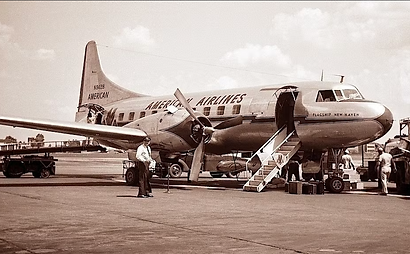
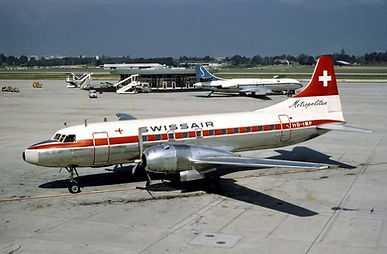
The Convair 240 marked a decisive shift from the rugged Douglas DC-3 era to modern, pressurized regional air travel. Unlike the DC-3, the 240 featured a pressurized cabin, allowing it to cruise above weather for smoother and faster flights. It was designed specifically as a DC-3 replacement, offering greater speed, improved passenger comfort, and a more modern tricycle landing gear layout. While it did not match the long-range capability of larger four-engine transports, the 240 excelled on short- to medium-haul routes, setting the foundation for a new generation of postwar feederliners.
Specifications
Powerplant: 2 × Pratt & Whitney R-2800 Double Wasp radial engines (2,400 hp each)
Wingspan: 91 ft 9 in (28.0 m)
Top Speed: 315 mph (507 km/h)
Range: ~1,200 miles (1,930 km)
Structure: Pressurized aluminum fuselage, low wing, tricycle landing gear
Capacity: 40 passengers
Cruising Altitude: ~20,000 ft (6,100 m)
Years of Service: 1948–1960s