

A New Era in the Skies
The 1960s ushered in a golden era of jet-powered travel, when sleek airliners like the Boeing 707 and Douglas DC-8 carried passengers farther and faster than ever before. Airports expanded, skies filled with contrails, and international travel became a symbol of modern life. This decade transformed aviation from an exclusive luxury into a defining feature of the connected world we know today.
1949
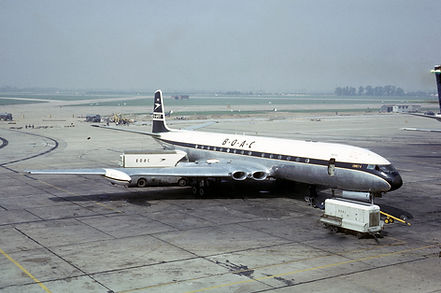
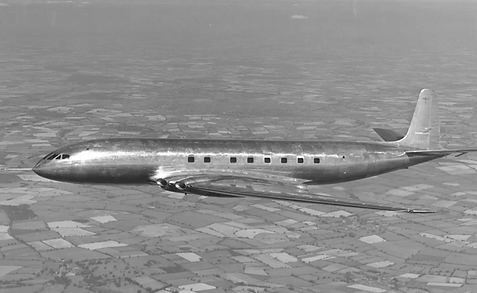
de Havilland Comet
The de Havilland Comet, developed and built in the United Kingdom by the de Havilland Aircraft Company, was the world’s first commercial jet airliner. Introduced in 1952 with BOAC (British Overseas Airways Corporation), it stunned the world with its sleek appearance, quiet cabins, and unprecedented cruising speed. However, early crashes caused by metal fatigue led to its grounding and redesign. Despite these setbacks, the Comet’s pioneering design and engineering breakthroughs laid the groundwork for every jetliner that came after.
Specifications
Powerplant: 4 × de Havilland Ghost 50 Mk1 turbojets (5,000 lbf each)
Wingspan: 115 ft (35 m)
Top Speed: 480 mph (770 km/h)
Range: 1,500–2,600 miles (2,400–4,200 km)
Structure: All-metal, pressurized fuselage
Capacity: 36–44 passengers
Cruising Altitude: 35,000 ft (10,700 m)
Years of Service: 1952–1980
1955
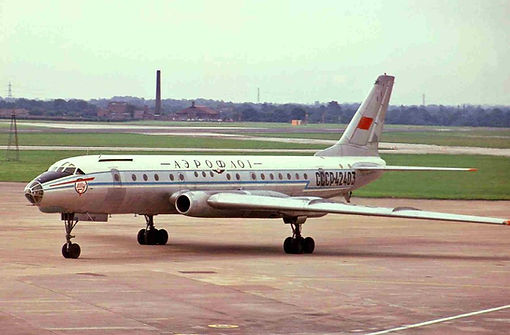
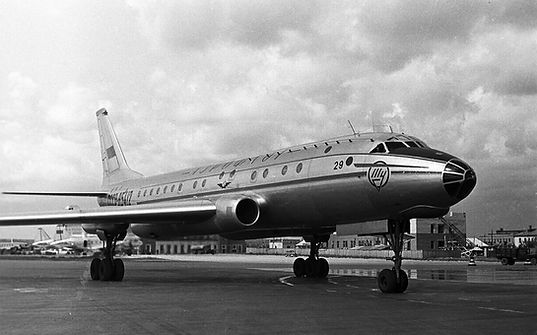
Tupolev Tu-104
The Tupolev Tu-104, developed by the Tupolev Design Bureau (USSR), first flew in 1955 and entered service in 1956 with Aeroflot. As the world’s second operational jet airliner, it marked a major milestone in Soviet aviation. Adapted from the Tu-16 bomber, the Tu-104 featured swept wings, two powerful Mikulin AM-3 turbojet engines, and a pressurized cabin accommodating up to 100 passengers.
Its debut made Aeroflot the first airline to operate a jet-powered passenger fleet on major routes, symbolizing Soviet technological progress during the early years of the Jet Age.
Specifications
Powerplant: 2 × Mikulin AM-3 turbojet engines (17,600 lbf thrust each)
Wingspan: 115 ft (35 m)
Top Speed: 540 mph (870 km/h)
Range: 1,500–2,200 miles (2,400–3,500 km)
Structure: All-metal, swept-wing monoplane derived from the Tu-16 bomber
Capacity: 50–100 passengers
Cruising Altitude: 39,000 ft (12,000 m)
Years of Service: 1956–1979
1957
Boeing 707
The Boeing 707, developed by the Boeing Company, first flew in 1957 and entered service in 1958 with Pan American World Airways. It was the jet that made global air travel accessible to the public, connecting continents faster and farther than ever before. Derived from Boeing’s KC-135 military tanker, the 707 featured swept wings, four powerful jet engines, and a pressurized cabin for a smoother, quieter ride. Its speed, range, and comfort set new industry standards and paved the way for future jetliners. More than just an airplane, the 707 became an icon of the Jet Age, transforming how the world traveled.

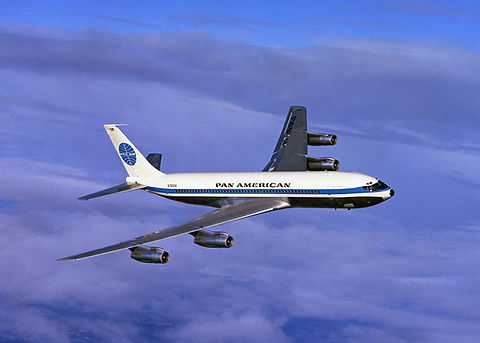


Specifications
Powerplant: 4 × Pratt & Whitney JT3C turbojet engines (13,500 lbf thrust each)
Wingspan: 145 ft (44 m)
Top Speed: 600 mph (965 km/h)
Range: 2,500–5,750 miles (4,000–9,200 km), depending on variant
Structure: All-metal, low-wing monoplane
Capacity: 140–189 passengers
Cruising Altitude: 35,000–41,000 ft (10,600–12,500 m)
Years of Service: 1958–early 2000s (some still used for military purposes)
-
707-120 – The original production version, powered by Pratt & Whitney JT3C turbojets and designed primarily for domestic U.S. routes. It established the 707 as one of the first successful American jetliners.
-
707-320 – The major long-range development, featuring a longer fuselage, larger wings, greater fuel capacity, and increased range for transatlantic and intercontinental routes. It became the most widely recognized 707 variant.
-
707-320B – Improved version featuring more efficient JT3D turbofan engines and aerodynamic refinements, significantly reducing fuel consumption and increasing range compared with earlier turbojet-powered 707s.
-
707-320C – Convertible passenger/freighter version with a strengthened floor and large cargo door. It became the final major production version and was widely used for both passenger and cargo operations.
Notable Variants
1959
Boeing 720
The Boeing 720, developed as a shorter and lighter derivative of the Boeing 707, first flew in 1959 and entered service in 1960 with United Airlines. Designed for shorter routes and airports with demanding takeoff conditions, the 720 featured a shortened fuselage, reduced weight, and modified wings that gave it better takeoff and climb performance than the larger 707. Although it was smaller, the 720 retained the speed and reliability of its predecessor and could carry around 120 passengers over medium-range routes. The improved 720B, introduced with Pratt & Whitney JT3D turbofan engines, offered better fuel efficiency and became the most successful version. With 154 aircraft produced, the 720 helped extend Boeing's early jetliner family beyond the 707's primary long-haul role.

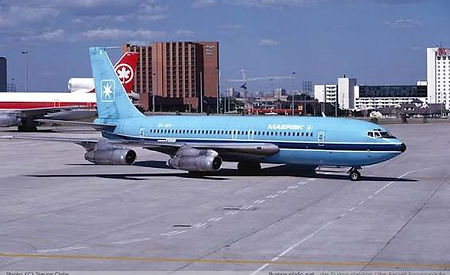
Specifications
Powerplant: 4 × Pratt & Whitney JT3C turbojet engines (720) or JT3D turbofan engines (720B), ~ 12,000–18,000 lbf each depending on variant
Wingspan: 130 ft 10 in (39.9 m)
Top Speed: 608 mph (979 km/h)
Range: 3,600 miles (5,800 km)
Structure: All-metal, low-wing monoplane
Capacity: 106–149 passengers (depending on variant)
Cruising Altitude: 35,000–40,000 ft (10,700–12,200 m)
Years of Service: 1960–1990s
1958
Douglas DC-8
The Douglas DC-8, developed by the Douglas Aircraft Company, first flew in 1958 and entered service in 1959 with United Airlines and Delta Air Lines. Designed to compete directly with the Boeing 707, the DC-8 shared similar performance but featured a slightly narrower fuselage and greater range flexibility. It quickly gained a reputation for its strength, smooth handling, and reliability. Over the years, the DC-8 underwent numerous upgrades—including quieter turbofan engines—that extended its operational life well into the 21st century, particularly in cargo service.

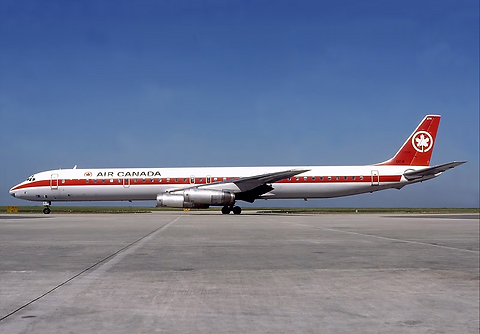

Specifications
Powerplant: 4 × Pratt & Whitney JT3C-6 turbojet engines (13,500 lbf each)
Wingspan: 142 ft (43.4 m)
Top Speed: 600 mph (965 km/h)
Range: 5,000 miles (8,000 km)
Structure: All-metal, low-wing monoplane
Capacity: 140–189 passengers (depending on variant)
Cruising Altitude: 35,000–41,000 ft (10,600–12,500 m)
Years of Service: 1959–present (virtually all retired; only one remains active — Samaritan’s Purse DC-8 N782SP)
-
DC-8 Series 10 – Original domestic U.S. version for shorter routes.
-
DC-8 Series 20 – Upgraded with more powerful Pratt & Whitney JT4A turbojets.
-
DC-8 Series 30 – Long-range intercontinental version with strengthened wings and increased fuel capacity.
-
DC-8 Series 40 – First jetliner certified with Rolls-Royce Conway turbofan engines, improving efficiency and reducing noise.
-
DC-8 Series 50 – Featured upgraded JT3D turbofan engines and improved performance.
-
DC-8 Super 60 – Stretched fuselage variants (DC-8-61/62/63) for greater capacity and range; among the most successful models.
-
DC-8 Super 70 – 1980s conversions of Super 60 aircraft with modern CFM56 turbofan engines, extending their service life and fuel efficiency.
Notable Variants
1959
Sud Aviation Caravelle
The Sud Aviation Caravelle, developed by the French Sud Aviation company, first flew in 1955 and entered service in 1959 with Scandinavian Airlines System (SAS). Designed for short- and medium-haul routes, the Caravelle was one of the first jetliners to successfully serve regional and European routes. Its most distinctive feature was its two engines mounted at the rear of the fuselage, keeping the wings aerodynamically clean and reducing cabin noise. The aircraft became known for its smooth ride, efficient operation, and innovative design, helping establish the rear-engined layout that would become common among later jetliners. More than 280 Caravelles were produced before production ended in 1972, and the type remained in service with airlines and other operators for decades.
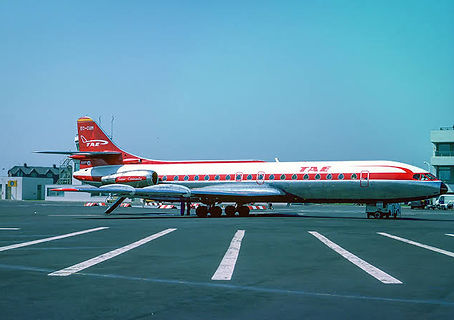

Specifications
Powerplant: 2 × Rolls-Royce Avon turbojet engines, depending on variant
Wingspan: 112 ft (34.3 m)
Top Speed: 515 mph (830 km/h)
Range: ~2,500 miles (4,000 km), depending on variant
Structure: All-metal, low-wing monoplane with rear-mounted engines
Capacity: 80–140 passengers (depending on variant)
Cruising Altitude: 35,000 ft (10,700 m)
Years of Service: 1959–2005
-
Caravelle I– The original production version. Important because it established the aircraft and entered commercial service in 1959.
-
Caravelle VI-R – A major improvement with more powerful engines, thrust reversers, and improved landing performance. It represented the mature early Caravelle.
-
Caravelle 10B (Super Caravelle) – Stretched and upgraded version with increased fuel capacity, improved range, and more powerful Pratt & Whitney JT8D engines.
Notable Variants
1960
Convair 880/990
The Convair 880, developed by Convair, first flew in 1959 and entered service in 1960 with Delta Air Lines. Designed to compete with the Boeing 707 and Douglas DC-8, the 880 emphasized speed, becoming one of the fastest subsonic commercial jetliners of its era. Its four General Electric CJ805 turbojet engines allowed it to cruise at higher speeds than many of its competitors, although its high fuel consumption limited its commercial success. The improved Convair 990, which first flew in 1961, featured a longer fuselage, increased fuel capacity, and modified wings with distinctive anti-shock bodies designed to reduce drag at high speeds. Despite their impressive performance, only 116 aircraft from the 880 and 990 family were produced, making them some of the rarest early jetliners.


Specifications
Powerplant: 4 × General Electric CJ805 turbojet engines, approximately 11,650–16,100 lbf each
Wingspan: 120 ft 5 in (36.7 m) for 880; 120 ft 10 in (36.8 m) for 990
Top Speed: 615 mph (990 km/h) for 880; 620 mph (998 km/h) for 990
Range: ~3,400 miles (5,470 km) for 880; ~4,100 miles (6,600 km) for 990
Structure: All-metal, low-wing monoplane
Capacity: 88–110 passengers for 880; 149 passengers for 990
Cruising Altitude: 35,000–41,000 ft (10,700–12,500 m)
Years of Service: 1960–1980s