
Pressurization & Fatigue
The Age of Air-Sealed Flight
The Promise of Altitude
In the early 1950s, jet-powered flight offered aviation something piston engines never could: the stratosphere. At 35,000 feet, jet engines operated in thin, cold air that offered dramatically reduced drag. Airline passengers could sit above turbulence, weather, and noise, cruising at over 500 mph in relative comfort.
But the stratosphere presented a fundamental problem for human biology. At 35,000 feet, the ambient air pressure is roughly one quarter of sea level pressure. Without intervention, passengers and crew would lose consciousness within minutes. The solution was cabin pressurization: pumping compressed air into the fuselage to maintain a cabin pressure equivalent to roughly 8,000 feet, an altitude the human body tolerates well.
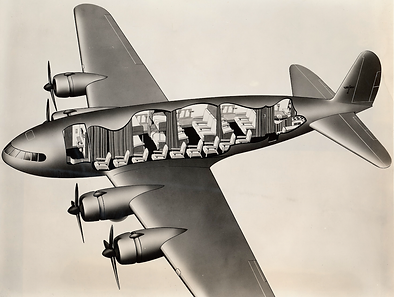
Pressurization was not new. The Boeing 307 Stratoliner had introduced it in 1938. But the jet age scaled it to an entirely new level. The de Havilland Comet, first flying in 1949, became the world's first jet airliner to enter scheduled passenger service in 1952. It flew faster and higher than anything that came before. And then, two years into service, it began to fall apart in the sky.
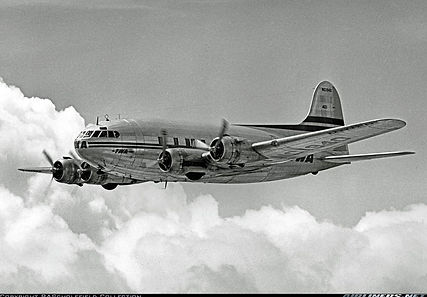
TWA's Boeing 307 in cruise, 1940.
The Interior of the Boeing 307 Stratoliner
Early Pressurization Failures
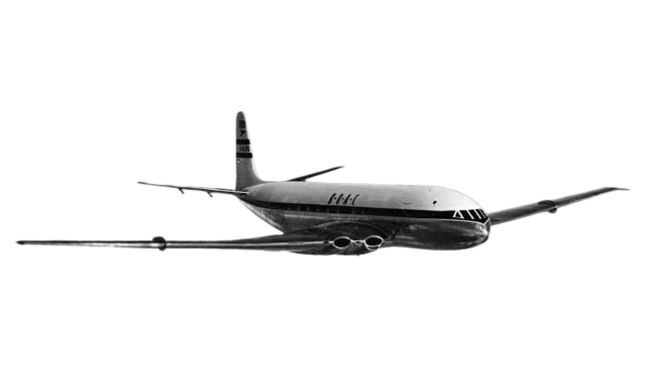
BOAC Flight 781 — G-ALYP (1954)
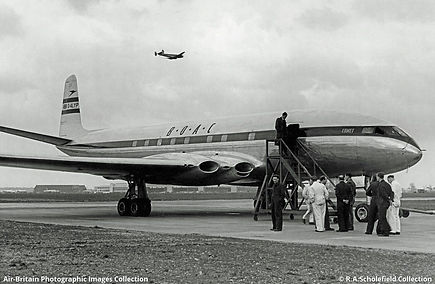
On January 10, 1954, BOAC Flight 781, operated by a de Havilland Comet 1, departed Rome’s Ciampino Airport on a flight to London. Approximately 20 minutes after takeoff, the aircraft suffered a catastrophic in-flight breakup over the Mediterranean Sea near Elba Island, Italy. The accident resulted in the loss of all 35 passengers and crew members onboard.
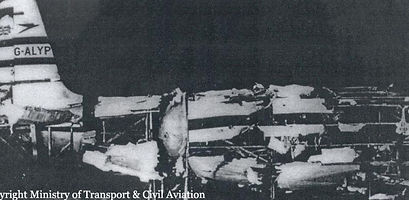
Aftermath of G-ALYP's crash
The subsequent investigation, one of the most thorough accident investigations in aviation history, used submerged pressurization testing of a complete airframe to simulate thousands of flight cycles in a controlled environment. Engineers repeatedly pressurized and depressurized the test aircraft to recreate the stresses experienced during normal operation. The aircraft eventually failed after simulated cycles equivalent to only 9,000 flight hours, far below the expected service life and revealing that repeated pressurization created structural weaknesses over time.
The investigation identified two critical design flaws in the Comet’s fuselage structure. First, the aircraft’s windows were approximately square with relatively tight corner radii. These sharp corners created areas of concentrated stress, where forces accumulated more intensely than they would around smoother, rounded shapes. Second, the rivet holes around the window openings had been punched rather than drilled, leaving microscopic cracks and imperfections in the aluminum structure. Under repeated pressurization cycles, these small flaws gradually grew into dangerous fatigue cracks, eventually weakening the aircraft’s pressure vessel.
Investigation
Operation ELBA: Finding the Answer
The Royal Aircraft Establishment at Farnborough conducted one of the most comprehensive aircraft accident investigations in aviation history up to that point. Engineers developed a groundbreaking test method to recreate the stresses experienced by the Comet during normal service. They placed an entire Comet fuselage inside a large water tank and repeatedly cycled its pressurization thousands of times, simulating years of flight operations in a matter of weeks.
Water was used instead of air for an important safety reason. Because water is nearly incompressible, a structural failure during testing would release far less stored energy than a failure involving compressed air. This allowed engineers to safely observe how the fuselage responded to repeated pressurization and identify the exact points where structural weaknesses developed.
The results were clear. After approximately 1,830 additional simulated pressurization cycles, the test fuselage failed when a crack formed at the corner of the forward Automatic Direction Finding (ADF) antenna window cutout. The crack then spread through the aluminum skin from the area of concentrated stress at the sharp corner, confirming that repeated pressurization cycles could gradually weaken aircraft structures. The findings fundamentally changed how engineers approached fatigue testing and the design of future pressurized aircraft.
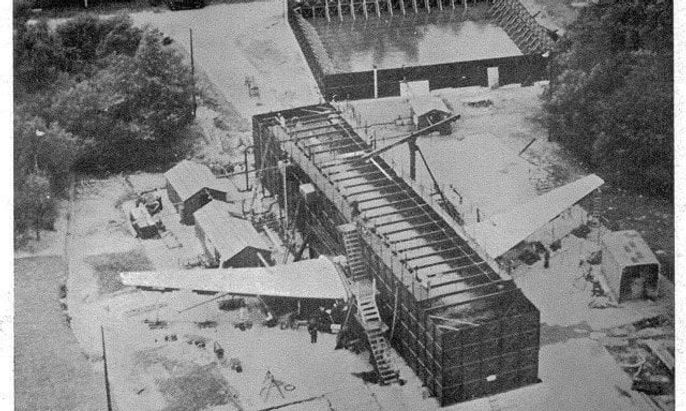
Farnborough water-tank fatigue test setup — Comet fuselage pressurization rig, 1954
Science of Pressure Cycle
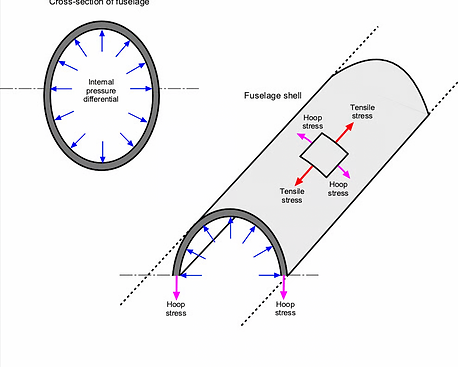
Every time a jetliner climbs to cruise altitude, the cabin must be pressurized to maintain a breathable environment for passengers and crew. At 35,000 feet, the outside atmosphere contains far less oxygen and pressure than the human body can safely tolerate, so aircraft systems pump compressed air into the cabin to create a comfortable internal environment.
The blue arrows in this diagram represent the force created by this internal pressure pushing outward against the fuselage walls. Unlike a simple container holding air, a pressurized aircraft fuselage becomes a pressure vessel that must continuously resist these forces throughout every flight. The pressure difference between the inside and outside of the aircraft creates tension in the fuselage skin, causing it to expand slightly like an inflated balloon.
The circular shape of the fuselage is critical because it distributes stress evenly around the structure. The diagram shows two main types of stress created by cabin pressure: hoop stress, which acts around the circumference of the fuselage, and tensile stress, which acts along its length. These forces are repeated every time an aircraft climbs, cruises, and descends, creating thousands of pressurization cycles over an aircraft’s lifetime.
The Two Stress Forces
Hoop Stress
Hoop stress is the tension that acts around the circumference of a pressurized fuselage, trying to expand it outward like an inflated balloon. It is the largest stress experienced by a cylindrical pressure vessel, which is why aircraft fuselages are designed with smooth, rounded shapes to distribute forces evenly. Repeated pressurization cycles can slowly weaken the material through metal fatigue if not properly managed.
Tensile Stress
Tensile stress is the pulling force that acts along the length of the fuselage, trying to stretch the aircraft from nose to tail. It is created as internal cabin pressure pushes against the front and rear pressure bulkheads. While lower than hoop stress, repeated tensile loading contributes to metal fatigue and must be carefully considered in aircraft design.
Stress Concentration
In an ideal structure, stress is spread evenly throughout the material. However, when a design contains sharp corners, holes, or sudden changes in shape, stress becomes concentrated in small areas. These locations experience much higher forces than the surrounding material and become natural starting points for cracks.
This problem played a major role in the de Havilland Comet disasters. The Comet was one of the first commercial jetliners to operate at high altitudes with a fully pressurized cabin, but its square-shaped windows created severe stress concentrations at the corners. During every flight, the cabin expanded slightly during pressurization and contracted during descent. Over thousands of cycles, these repeated stresses caused tiny cracks to form around the window corners.
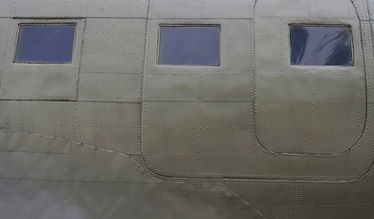
VS

Modern aircraft avoid this problem by using rounded windows with larger corner radii. The curved shape allows forces to flow smoothly around the opening, reducing stress buildup and greatly improving fatigue resistance. The lessons learned from the Comet permanently changed how engineers design pressurized aircraft structures.
Rebuilt of Industry
Window Design
Fully Rounded Oval
No sharp corners — stress distributes uniformly around the frame
Riveting Method
Drill-riveted only
Eliminated punch-riveting micro-cracks at hole edges
Skin Thickness
Increased gauge
Heavier skin reduced stress levels at all points, increasing fatigue life
Fatigue Testing
Full lifecycle simulation
Entire airframe tested to multiple design lifetimes before first flight
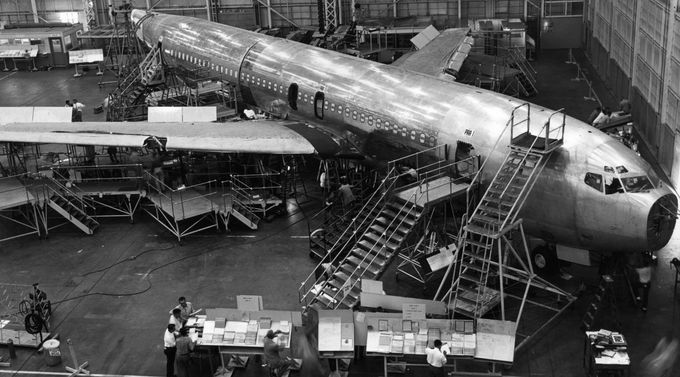
The Boeing 707 Jet Stratoliner Number One under construction at Boeing's Transport Division in Renton, Washington; 1958