
The All-Metal Breakthrough
Aluminum Revolution
The Metal That Changed Everything
In 1906, German metallurgist Alfred Wilm discovered something remarkable: aluminum mixed with small amounts of copper, magnesium, and manganese could be heat-treated to become nearly as strong as steel, at one-third the weight.
He called it Duralumin. The aviation world called it revolutionary.
By the 1920s, aircraft designers had reached the limits of wood and fabric. Engines were more powerful. Speeds were climbing. And passengers expected reliability, not adventure. The transition to metal wasn't just an improvement, it was a necessity.
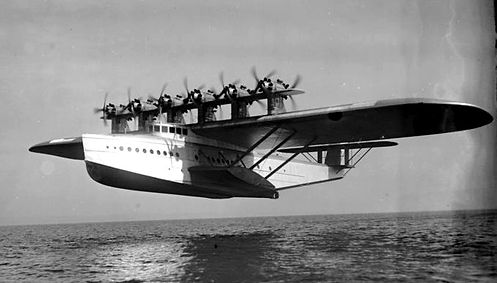
Dornier Do X, an all duralumin built aircraft
Stressed-Skin Construction
Monocoque & Semi-Monocoque Design
In a stressed-skin design, the outer aluminum shell is riveted to internal frames and stringers, creating a structure where the skin carries aerodynamic and structural loads. This eliminated the need for external bracing wires, dramatically reducing drag and increasing strength.
Monocoque (single-shell) construction used the skin alone to carry all loads; like an eggshell. Semi-monocoque added internal frames and stringers for reinforcement, becoming the industry standard. The result: aircraft that were lighter, stronger, and far more aerodynamically efficient than anything built from wood. Drag dropped by 40%. Range doubled. And for the first time, aircraft could be mass-produced with consistent quality.

3X
Strength-to-weight ratio vs. wood
40%
Reduction in aerodynamic drag
2X
Increase in operational range
A comparison of Monocoque and Semi Monocoque (Tsunami Air)

Factory floor, November 1944: the B-24 Liberator under construction, showcasing stressed-skin metal design with duralumin.
Duralumin
Pure aluminum is light but soft, too soft for structural use. The breakthrough came in 1906 when German metallurgist Alfred Wilm discovered that adding small amounts of copper, magnesium, and manganese to aluminum and then heat-treating it produced an alloy dramatically stronger than any of its constituents: Duralumin. By the 1920s, it had become the defining material of modern aircraft construction.
What made Duralumin remarkable was its combination of properties. It was roughly one-third the weight of steel. Its tensile strength, after heat treatment, approached that of mild steel. It could be formed, rolled, extruded, and machined with conventional tools. And it formed a natural oxide layer that provided corrosion resistance far superior to steel.
The alloy was further refined through the 1930s and 1940s into the 2000-series and 7000-series aluminum alloys that are still used in aircraft structures today. Each refinement pushed the strength-to-weight ratio higher, allowing thinner skins, lighter frames, and more efficient structures.
The Pioneers

Junkers F 13 | 1919
The Junkers F 13 was the world’s first all-metal passenger aircraft and a major milestone in the development of commercial aviation. Introduced in 1919, it pioneered the use of Duralumin for its corrugated metal airframe, creating a structure that was stronger, more durable, and less vulnerable to weather than traditional wooden aircraft. Its enclosed passenger cabin was revolutionary, offering comfort and protection from the elements. The F 13’s advanced construction techniques influenced future aircraft designs and demonstrated the potential of metal airframes in aviation.
The Boeing 247 was one of the first truly modern airliners and represented a major leap forward in commercial aviation during the 1930s. Introduced in 1933, it featured an all-metal semi-monocoque fuselage, retractable landing gear, variable-pitch propellers, and a low-wing design that reduced drag and improved performance. Powered by two Pratt & Whitney Wasp radial engines, the 247 could cruise faster than many military aircraft of the era while carrying passengers in a comfortable enclosed cabin. Its streamlined construction and advanced engineering made it one of the most sophisticated passenger aircraft of its time, transforming expectations for speed, safety, and efficiency in air travel.
Boeing 247 | 1933

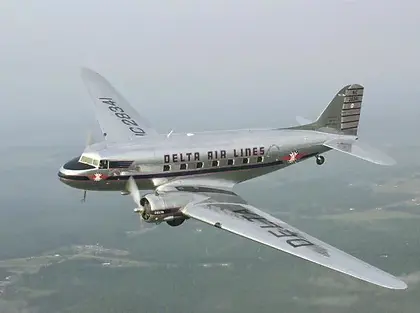
Junkers F 13 | 1936
The Douglas DC-3 was one of the most influential airliners in aviation history, transforming commercial air travel during the 1930s. Introduced in 1936, it featured an all-metal semi-monocoque fuselage, retractable landing gear, and powerful twin Wright Cyclone radial engines that provided greater speed, range, and reliability than earlier aircraft. Its spacious cabin, sleeping berths, and improved passenger comfort made long-distance travel more practical and profitable for airlines. The DC-3’s exceptional efficiency and rugged construction allowed it to serve reliably in both civilian and military roles, including its famous C-47 Skytrain variant during World War II.
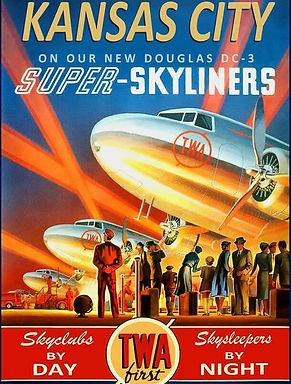
Sleek aluminum and streamlined design: TWA’s vision of modern air travel in the 1930s–40s
Legacy
The aluminum revolution transformed aircraft from fragile flying machines into reliable transportation systems. Unlike wood and fabric structures, aluminum alloys offered greater strength, durability, and resistance to environmental damage while allowing engineers to create smoother, more aerodynamic designs. This shift enabled aircraft to fly faster, carry heavier loads, and operate at higher altitudes with far greater confidence.
The adoption of aluminum also changed the future of commercial aviation. All-metal airframes could withstand thousands of hours of operation, making regular airline schedules and long-distance passenger routes practical. Aircraft such as the Boeing 247 and Douglas DC-3 demonstrated that aviation could become a dependable form of transportation rather than a risky adventure.
The importance of aluminum extended beyond aircraft structure and into aviation’s visual identity. American Airlines became famous for its polished aluminum livery, which showcased the natural shine of the aircraft’s metal skin instead of covering it with heavy paint. This design not only created a distinctive appearance but also reduced weight by minimizing paint usage, reflecting the efficiency and practicality that aluminum brought to aviation.
The polished metal livery became a symbol of the Jet Age, appearing on iconic aircraft such as the Boeing 707, Boeing 747, and McDonnell Douglas DC-10. It represented an era when aluminum was not just a hidden engineering material, but a visible expression of speed, reliability, and modern air travel.

American Airlines B747-100 wearing its iconic polished aluminum livery